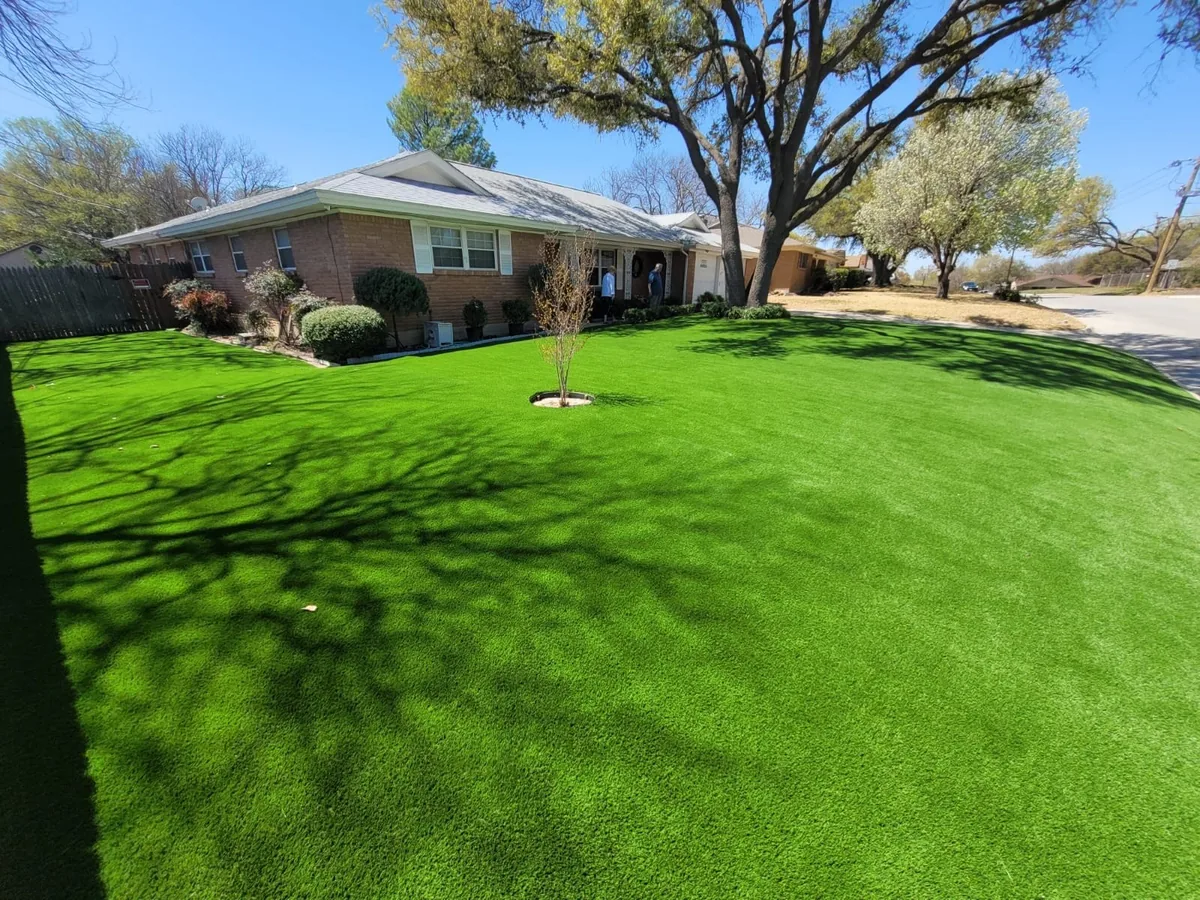
Short answer
One manufacturer's guide says high-quality artificial turf can last 10 to 15 years with proper installation and maintenance, and gives at least 8 to 10 years for high-quality residential turf. Those are a seller's estimates. In a University Park backyard, full summer sun and heavy traffic may shorten that, and shade and routine brushing may help.
Everyone wants one number for "how long does artificial turf last in Texas heat," and the fair answer is a range with conditions attached. The numbers people quote usually come from companies that sell turf, and a Dallas summer may push against them, because strong sun is one of the things that ages the fibers. We wrote this for small backyards where a pool deck or a dog path takes most of the use, and our artificial turf Park Cities Dallas homepage has more on those yards.
What actually wears out on artificial turf?
Turf tends to age in four places, and they can fail on different schedules.
The fibers are the first thing to watch in full sun. Ultraviolet light gradually breaks down the polymer in each blade, so the color can dull and the blade can lose its spring. A manufacturer's lifespan guide says low-quality turf in direct sunlight can fade and become brittle, and that even high-quality turf can fade gradually over the years. The same guide says high-quality turf can last 10 to 15 years, in some cases up to 20, with proper installation and maintenance, and its conclusion gives at least 8 to 10 years for high-quality residential turf. It adds that actual longevity depends on usage, maintenance and environmental conditions.
Infill tends to move too. Sand or coated granules sit between the blades to help hold them upright and weigh the turf down, and rain, rinsing, dogs and foot traffic can push that material toward low spots. Blades with little holding them up tend to lie flat and look worn.
Seams are the third weak spot, since rolls are generally joined with tape and adhesive that heat cycles work on for years. A seam that lifts even a little can catch a toe and let weeds in.
The base can also move, because North Texas clay tends to swell when wet and shrink when dry. A thin or poorly compacted stone base may follow it, and that can show up as puddles or as seams that no longer line up.
How does Texas heat change the timeline?
Heat is probably hardest on the fibers and the seams, although the research we found measures surface temperature and says nothing about how long turf lasts. A 2011 trade article on Penn State's sports surface research says it is not uncommon for synthetic surfaces to pass 150 degrees Fahrenheit, that Penn State recorded 175 on its research plots, and that natural grass rarely reaches 100. Those are sports field numbers and peak readings, so a shaded backyard should run cooler. Even a cooler surface goes through a lot of hot afternoons from June to September, and the adhesive and the yarn may feel that over the years.
The same article says watering cools a surface quickly and that temperatures rebound 20 minutes after the irrigation stops. That helps on a pool afternoon, though it is unlikely to do much for aging.
Shade and placement probably make the bigger difference. A backyard under live oaks tends to get far less direct sun than a west-facing open lawn. Our pool surround turf University Park page covers the opposite case, with full sun and splash water. That strip is likely to age before a shaded lawn does, so ask any installer which yarn and infill they would use there and why.
What does a premium grade change?
Better landscape turf generally uses polyethylene yarn with UV stabilizers built into it, a heavier face weight so more blades share the wear, and a shaped blade that tends to spring back. Many products use a polyurethane backing, which is often sold as holding tufts tighter than latex and handling heat better. Ask your installer to name the yarn and the backing in writing. Turf grade is also one of the things that sets the price, and our Dallas artificial turf cost guide has the typical ranges.
The parts you never see matter too. We compact crushed stone in layers and grade it so the lawn can drain, because a stable base helps seams stay aligned when the clay underneath moves. We run the grain one way, hide the seams and secure the edges to help keep them down through a hot August.
Heavier use generally calls for a denser product, so a play area under a swing set and a quiet courtyard may need different turf. Our play and sport turf University Park page goes further on that.
Which maintenance habits help turf last?
The manufacturer's guide lists routine brushing, debris removal and rinsing among the things that help turf last. Brush against the grain every few weeks with a stiff broom, especially in the dog's path and the route from the back door to the gate. Blades that stand up tend to wear more evenly.
Top up infill where it has thinned. If you can see the backing between blades in a traffic lane, the infill has probably migrated, and raking in a bag of the same material can restore some of the support. Check pet turf more often, since rinsing tends to move infill along.
Clearing the surface helps as well. Leaves left over winter can hold moisture against the backing, pecan husks can stain, and organic debris gives weeds a place to start. A blower on a dry day handles most of it. Rinse by hand with a hose when pollen or dust builds up, within your city's watering rules. If you hose down a sunny area to cool it for the kids, remember it can heat back up in about 20 minutes.
Rubber infill raises its own questions, and the EPA's federal research on recycled tire crumb covers playing fields and playgrounds, describes likely exposure as limited, and says its reports are not a risk assessment. Ask your installer what infill they plan to use.
Frequently Asked Questions
How many years does artificial turf last in a Dallas backyard?
A manufacturer's guide we cite says high-quality turf can last 10 to 15 years, in some cases up to 20, and gives at least 8 to 10 years for high-quality residential turf. Shade, traffic and product grade can move a Dallas yard around in that range, and shaded yards will likely age more slowly.
Does artificial turf fade in Texas sun?
Over time, yes, and low-quality products can fade and turn brittle. Ultraviolet light gradually breaks down the polymer in each blade, dulling color and reducing spring. Better turf generally has UV stabilizers built into the fiber, which can slow that process, and shade from mature trees should cut the sun exposure too.
Why do artificial turf seams start to show after a few years?
Heat, base movement or both are the usual suspects. Heat cycles work on the seaming adhesive year after year, and a thin or uneven stone base can move with the clay underneath and pull two rolls out of alignment. A compacted stone base and secured edges generally help seams stay put for longer.
How often should turf be brushed and topped up with infill?
Brush the traffic lanes every few weeks with a stiff broom, and more often where the dog runs. Check infill once or twice a year, and add the same material wherever backing shows between blades. Clear leaves and pecan husks each fall, and rinse by hand when pollen or dust builds up.
Ready to Get Started in University Park?
University Park Turf Co. serves University Park and the surrounding area. Send us a few details and we'll put together a written quote.