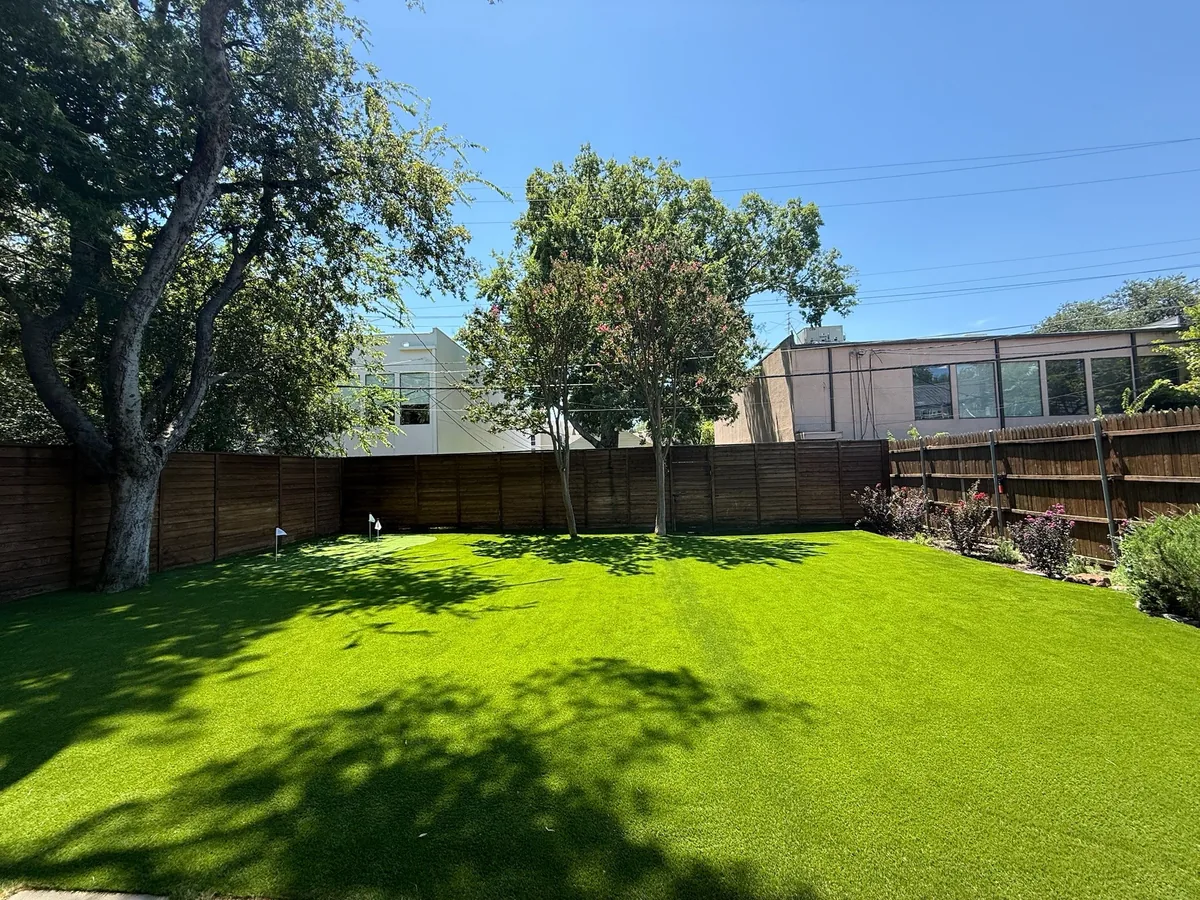
Short answer
In a University Park backyard under mature trees, artificial turf is often the better fit once the lawn gets less than four hours of sun, because more sod is unlikely to fix a light problem. Texas A&M AgriLife Extension puts St. Augustine's need at four to six hours of sunlight. With that much sun, repairing the grass usually costs less.
The third spring the grass under an oak dies, artificial turf vs St. Augustine shade starts to feel like a real choice. The yard is small, the trees are older than the house, and the sod that went down in April was gone by August. If that sounds familiar, the likely problem is light, and fertilizer can't add any. The short version is on our turf for shaded yards homepage. Turf is what we sell, so keep that in mind as you read about when to switch and when to stay with grass.
Ready to get a quote in University Park? Send us the details and we'll follow up.
Get a QuoteWhy does St. Augustine keep dying under Park Cities trees?
St. Augustine handles shade better than most warm season grasses, but it still needs some sun. Texas A&M AgriLife Extension says it requires four to six hours of sunlight to survive. A backyard behind an older house on a narrow lot, with big trees on both sides, may not get that much for a whole summer.
Live oaks tend to make this harder because they stay leafy through the year, so the ground under one stays dim in every season. A pecan at least drops its leaves for part of the year.
When the light runs short, the grass tends to stretch for whatever it can find. The blades get long and thin, the runners stop knitting together, and bare soil starts to show. A hot spell in July can then take out whatever is left. If your yard is in Highland Park or Greenway Parks and sits under big trees, you may recognize this.
What does another round of sod involve?
Each new round means buying the pallets, paying someone to lay them, adding some soil, and watering until the sod roots in a Dallas summer. Sod prices move around, so your landscaper is the right person to ask for a number.
Water is part of that bill too. The EPA's WaterSense program says that, depending on the region, homeowners use between 30 and 70 percent of their water outdoors, and it reports that experts estimate 50 percent of the water used outdoors goes to waste from evaporation, wind or runoff due to overwatering. Those are general figures, so your own water bill will tell you more. A shaded lawn usually needs less water than one in full sun, and new sod still needs steady watering while it gets established.
Then there is how the yard lives day to day. Bare dirt gets tracked into the house and the dog finds the mud before you do. For a lot of homeowners, we suspect that is the part that finally gets old.
What changes when turf goes in under the trees?
Turf doesn't need sunlight, so the darkest corner of the yard can look about the same as the brightest. In a backyard this shady, that may be reason enough.
What matters then is how the turf is chosen and built. In low light, one flat bright green tends to look like plastic. A blade with mixed tones and a brown thatch layer tends to look more like grass, and that is the kind we reach for. We build on crushed stone compacted in layers so the lawn can drain, which matters under a canopy that keeps dripping after a storm. Near a mature tree we adjust the dig and the base depth around surface roots to avoid cutting through them, and a large tree deserves an arborist's opinion before anyone digs.
Shade may also be easier on the turf. Direct sun is what heats a synthetic surface and, over the years, can fade the fibers, so a dim yard should ask less of it. Under heavy trees, plan on clearing leaves and rinsing now and then, since a shady spot can stay damp longer. Our backyard turf lawns University Park page has more on small yards under big trees.
On price, backyard turf typically runs $10 to $12 per square foot installed, with size, base prep and turf grade setting where a yard lands. At those rates a 400-square-foot shaded lawn would be somewhere around $4,000 to $4,800, which is rough arithmetic and leaves the real number to a written quote. The full breakdown is in our Dallas artificial turf cost guide.
When is grass still the right call?
If your yard gets a solid four to six hours of sun and the grass is failing anyway, the trouble may be compaction, a fungus, chinch bugs or a sprinkler zone that stopped working. A good lawn company can often fix those for far less than a turf job costs, so that is the place to start.
If the shade is light and the tree is young, a careful trim to raise the canopy may bring back enough sun for grass. An arborist should make that call.
And if you love the feel and smell of a real lawn, that counts for a lot. Turf will never smell like a cut lawn, and that might bother you more than you expect. In those yards a middle path can work: keep St. Augustine where the sun reaches and put turf only in the dead zone under the canopy, with the transition set along a bed edge so it looks planned. If you live in Highland Park, keep this kind of split to a backyard the public can't see, since the town code does not allow turf in a front yard or anywhere visible from its streets, sidewalks, parkways or alleys. Please confirm the current rules with the town first.
Frequently Asked Questions
How much sun does St. Augustine need in University Park?
Texas A&M AgriLife Extension says St. Augustine requires four to six hours of sunlight to survive, and that it tolerates shade better than most warm season grasses. A University Park backyard under a mature live oak may fall short of four hours through the growing season, which can leave the lawn thin and patchy.
Does artificial turf look fake in a shaded backyard?
It can, if the wrong grade goes in. One bright green blade tends to look plastic in soft light. Turf with mixed tones and a brown thatch layer tends to look more like real grass under trees, and tidy edges help. Ask to see the product in your own yard's light before you decide.
Will tree roots be damaged when the old lawn comes out?
It depends on the tree and how close the work gets. Digging and compacting stone over a root zone can stress a tree, so we suggest talking to an arborist before any dig under a mature oak. Where roots run near the surface, we adjust the base depth around them to avoid cutting through.
Should I try one more round of sod before switching to turf?
If the lawn gets at least four hours of sun, another round may be worth it, because the problem may be fixable and sod usually costs less up front. If the yard has been dim all day for years and each spring's sod is gone by August, more sod is unlikely to help.
Ready to Get Started in University Park?
University Park Turf Co. serves University Park and the surrounding area. Send us a few details and we'll put together a written quote.