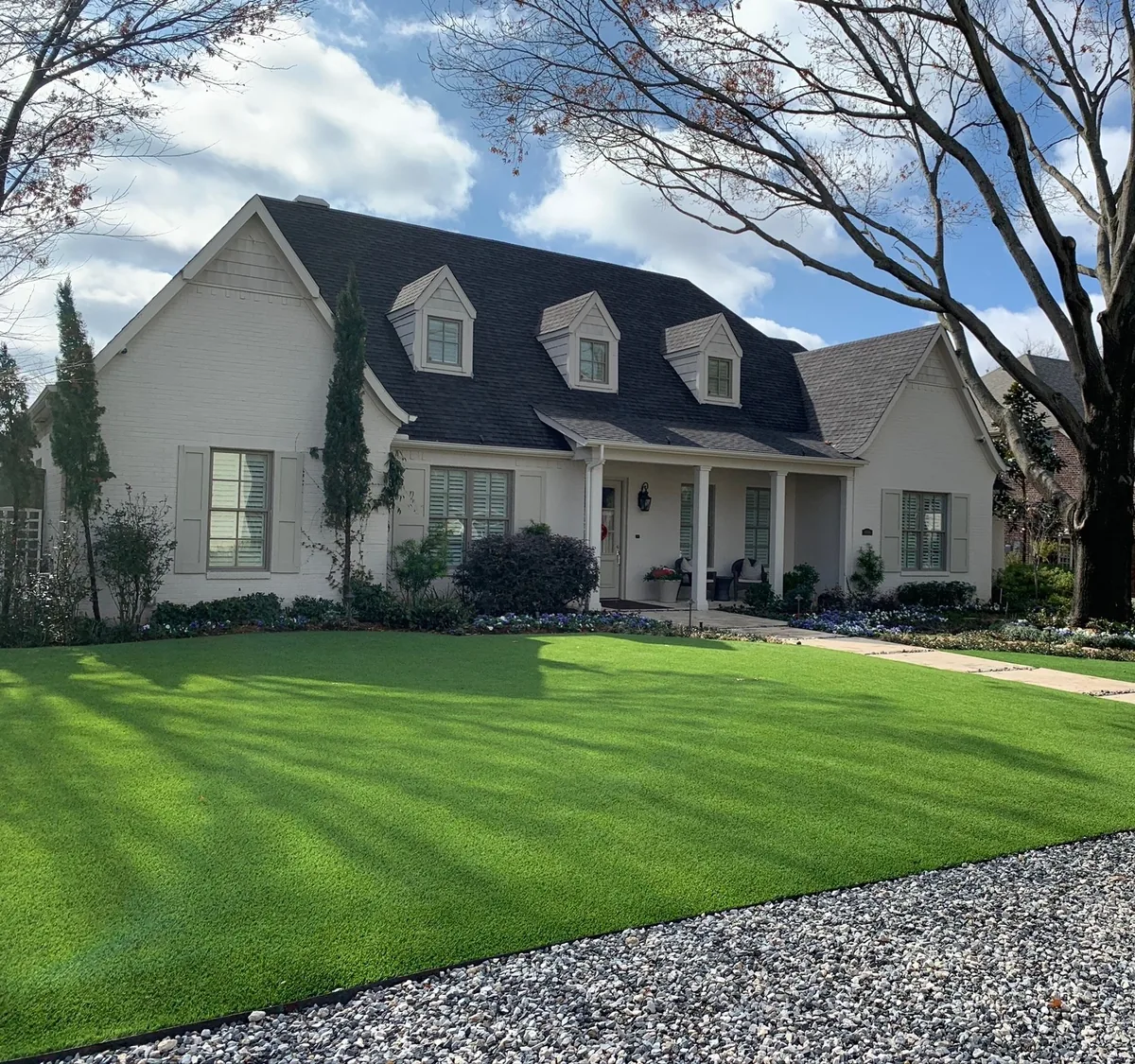
Short answer
Highland Park's town code makes it unlawful to install artificial turf in a front yard, or in any yard where the turf is visible from the town's streets, sidewalks, parkways or alleys. Turf anywhere else in town needs a building permit first. University Park's published pages do not show a citywide rule, so get the city's answer in writing.
The rules for an artificial turf front yard in University Park and in Highland Park are different, so the answer depends on which side of the city line you live on and on paperwork only your city can sign off on. We would love to say yes to the front yard, and we can't until your city does. Our artificial grass University Park homepage covers the backyard work we can say yes to today.
What does Highland Park's code say about artificial turf?
Highland Park's rule is Section 3.01.002, "Artificial turf," of the Town of Highland Park code. It makes it unlawful to construct or install artificial turf in the front yard of a lot within the town, or in a yard such that any portion of the turf is visible from the town's streets, sidewalks, parkways or alleys. That ban does not apply to property whose primary use is civic, meaning a public school, university or government facility, where the turf is used for playgrounds or athletic or sports fields. The section also makes it unlawful to install turf in any easement or parkway within the town. The front yard ban goes back to 2012, according to a 2017 People Newspapers report on the rule. Please confirm the current text with the town before you plan anything.
Anyone who wants to install artificial turf in the town must first get a building permit. The application includes a plan drawn to scale showing the outline of all structures, the location, height and materials of all fences, and the location of the proposed turf with dimensions, along with a description of specifications and installation instructions. The town's Community Development page lists artificial turf among the projects that need a permit, and it says permits are required before construction begins.
The same section sets installation standards. Turf goes in per the manufacturer's specifications, base layer and infill included. Blades and backing must be lead-free polyethylene, vegetable-based, or a combination, and nylon and plastic are prohibited. Colors must mimic natural turf, and blades on residential installations must be between 1 1/2 and 2 1/2 inches long. Drainage must maintain positive flow and follow the existing drainage patterns on the lot or comply with an approved drainage plan, and it may not create runoff onto adjacent private property. Seams must be sewn, edges must not be visible, and the turf must be permanently anchored.
Upkeep is in the code too. Turf must be kept clean and free of weeds, holes, tears, stains, discoloration, fading, seam separations, uplifted surfaces, depressions and excessive wear. Damaged and worn areas must be repaired or removed and replaced so the appearance is consistent, and the turf must be maintained to prevent compaction and flattening.
So in Highland Park the code rules out a front yard, and a backyard out of public view still needs a permit. Ask the town how it treats a corner lot and how it judges what can be seen from an alley, so a dog run along the alley fence gets an answer before you measure it.
What do University Park's web pages say?
The City of University Park's Community Development department administers the building codes and zoning ordinances. Its published web pages on building permits, zoning and codes did not show a citywide rule on artificial turf when we checked them.
That leaves the question open, and a web page can't stand in for an answer from the city. Please get an answer in writing from Community Development before you plan anything out front.
The department's phone number is on the page linked above, and the office is at the Peek Municipal Service Center on Worcola Street.
How do you check your own lot?
For University Park, call Community Development and describe what you have in mind: a front yard, a side yard visible from the street, or a fenced backyard. Ask whether a permit is required and whether any zoning or landscaping standard applies to your lot. Write down who you spoke with and the date, and ask them to confirm the answer in writing.
For Highland Park, call the town's Community Development office about the current code, the permit for anything out of public view, and how they judge visibility from the alley.
Then read your deed restrictions. If your street or townhome project has an association, a covenant on ground cover or landscape materials could be stricter than the city.
Does Texas law protect artificial turf from an HOA?
Section 202.007 of the Texas Property Code is the statute people usually point to, and it is worth reading closely. It says a property owners' association may not prohibit an owner from using drought-resistant landscaping or water-conserving natural turf, and that a provision doing so is void. It does not name artificial or synthetic turf. It also leaves an association free to require a landscaping plan for review, to restrict the type of turf used in new plantings, and to regulate gravel, rocks and cacti.
We aren't lawyers, and we would not tell anyone that this statute makes an HOA accept synthetic grass. It may give you an opening to talk about water-wise landscaping in general, but its rule that an association can't unreasonably deny a landscaping plan covers drought-resistant landscaping and natural turf, so it may not help a synthetic plan. Please confirm what your HOA will approve, and if your covenants are the obstacle, a real estate attorney is the right next call.
Where we can help today is behind the fence. A side yard dog run or a backyard lawn under the trees can often go ahead sooner, as long as it meets your city's rules on visibility and permits. Typical prices for that kind of job are in our Dallas artificial turf cost guide. Our pet turf University Park TX page has more on the dog side.
Frequently Asked Questions
Can I put artificial turf in my front yard in Highland Park, Texas?
No. Section 3.01.002 of the town code makes it unlawful to install artificial turf in a front yard, or in any yard where any portion of the turf is visible from the town's streets, sidewalks, parkways or alleys. Turf elsewhere in town needs a building permit first. Confirm the current text with the town before you plan.
Does University Park, Texas allow artificial turf in front yards?
The city's published web pages on permits, zoning and codes did not show a citywide rule on artificial turf when we checked, and that doesn't settle the question. Call Community Development at the City of University Park, describe your lot and the exact location, and get the answer in writing before planning anything.
Does Texas law stop my HOA from banning artificial grass?
Texas Property Code Section 202.007 protects drought-resistant landscaping and water-conserving natural turf, and it does not name artificial or synthetic turf. An association can still require a landscaping plan for review and restrict the type of turf planted. Read your covenants, confirm with your HOA, and talk to a real estate attorney if the HOA is the obstacle.
Do I need a permit for backyard turf in the Park Cities?
In Highland Park, yes. The town code says anyone who wants to install artificial turf must first get a building permit, and the application includes a plan drawn to scale. In University Park, the building permit and zoning pages we reviewed do not mention turf, so ask Community Development whether your project needs one, and get the answer in writing.
Ready to Get Started in University Park?
University Park Turf Co. serves University Park and the surrounding area. Send us a few details and we'll put together a written quote.